


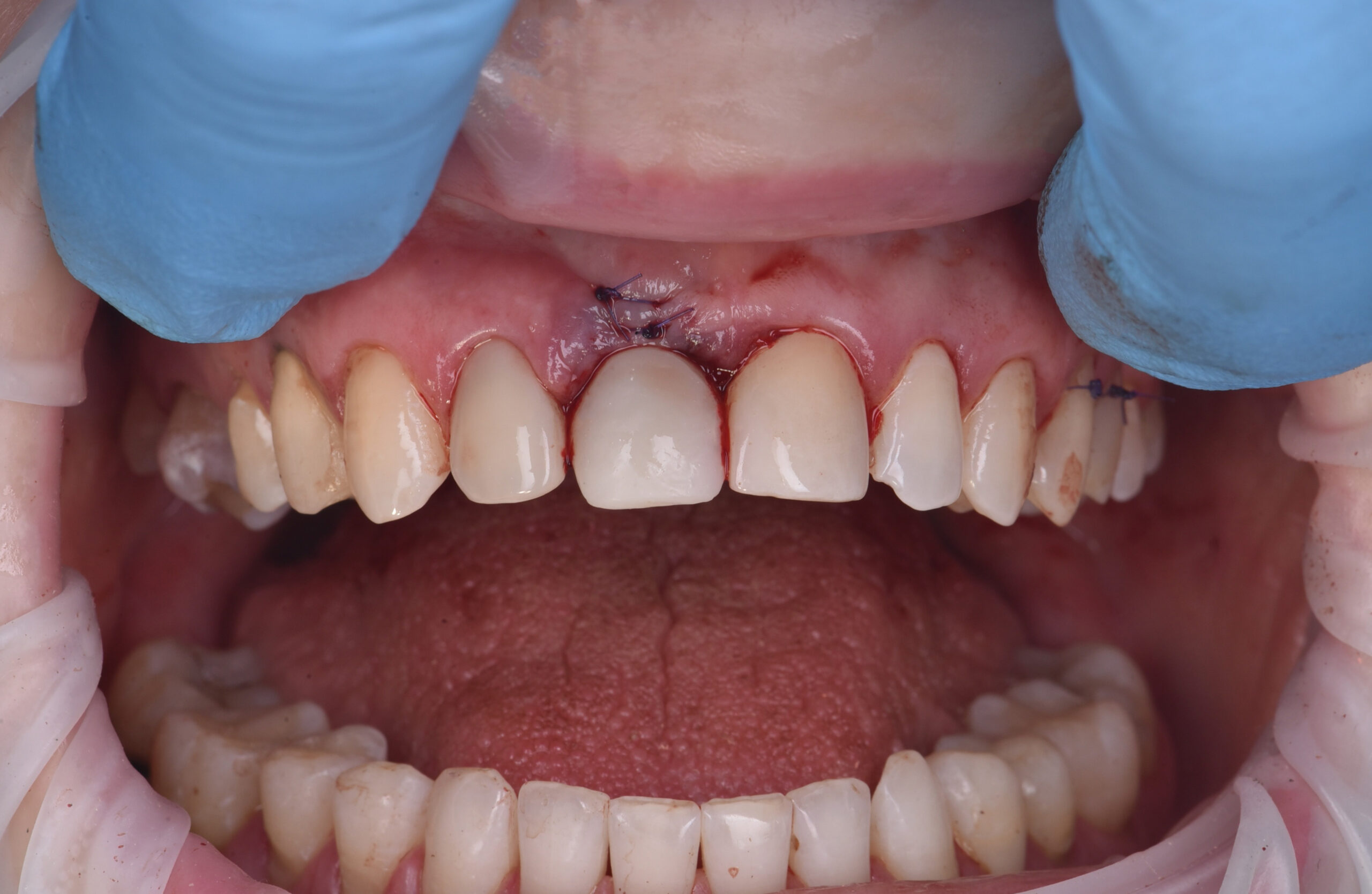
After root removal, a Straumann implant was immediately placed in the extraction socket, and a provisional plastic crown was provided for immediate aesthetic rehabilitation.
The photo shows a temporary abutment placed in the implant. A temporary plastic crown will be made on this abutment.

Temporary crown made directly during the surgery.


Final clinical photo demonstrating permanent zirconia restorations (crowns). to improve aesthetics, two neighboring teeth with large composite fillings were also covered with crowns for reinforcement.
Excellent integration of the three zirconia restorations into the patient’s overall smile is observed.

Preparation for permanent crown restorations and the implant gingival sulcus. Two adjacent teeth were carefully shaped. The gums around the implant are healthy and sufficient in volume, ensuring long-term aesthetics and biological protection..

Permanent zirconia crown with ceramic layering. The correct tooth contour and emergence profile can be seen, which is important for a natural-looking restoration.

Final result – view from the palatal side.
This view allows evaluation of the proper palatal orientation of the implant abutment. The hole in the crown corresponds to the screw-retained fixation, which is preferable to cementation, as cement retention is only used when the implant angulation is suboptimal and the hole would appear on the front surface. Avoiding cement helps prevent peri-implant inflammation.
The patient also received quality treatment for all other teeth.


Final X-ray with the permanent crown shows perfect implant placement and integration, as well as the correct emergence profile of the restoration, ensuring a stable and long-lasting result.


