


- Home
- Dentistry
- Dental surgery
- Wisdom tooth extraction
Wisdom tooth extraction in Ivano‑Frankivsk

Why wisdom teeth appear and when they become a problem
Wisdom teeth are the last teeth in the dental arch, usually appearing between the ages of 17 and 25. They were naturally intended as a “reserve” in case other teeth were lost, but in modern humans, the jaw is often smaller than that of our ancestors. As a result, there is often no space for the “eighth” tooth.
According to statistics, in 35–40% of people, wisdom teeth either do not erupt at all or grow incorrectly, causing problems.
Our chief surgeon recommends removing wisdom teeth in 100% of cases.
- But the main reasons for removing a wisdom tooth, according to the doctor, are in cases when:
- the tooth erupts at an angle, pushing on the neighboring tooth;
- It is affected by decay, which is difficult to treat due to limited access;
- causes gum inflammation or persistent pain;
- there is no space for it to erupt properly.
- when orthodontic treatment is required
When is it necessary to remove "wisdom teeth"?
Considering the significant evolutionary changes in human lifestyle and diet compared to our ancestors, our bodies have also adapted. As a result, modern humans no longer need wisdom teeth, and sometimes they can even cause problems. That is why our specialists recommend removing wisdom teeth whenever they cause discomfort. There are several reasons for this:
- Most people don’t have sufficient room in their jaws, so as the wisdom teeth emerge, they push on adjacent teeth, leading to crowding and crooked teeth.
- Often, wisdom teeth grow into the cheek, causing painful chewing and constant irritation of the soft tissue.
- Crooked wisdom teeth can cause uneven contacts, leading to jaw muscle strain and teeth grinding, which may eventually result in tooth wear.
- Maintaining proper hygiene near wisdom teeth is challenging, for both daily care and professional cleaning.
- Due to inadequate hygiene, cavities can develop quickly on wisdom teeth, and they are often very difficult to treat effectively.
- Poor hygiene around wisdom teeth can also lead to periodontal problems.
- Often, wisdom teeth do not participate in chewing at all.
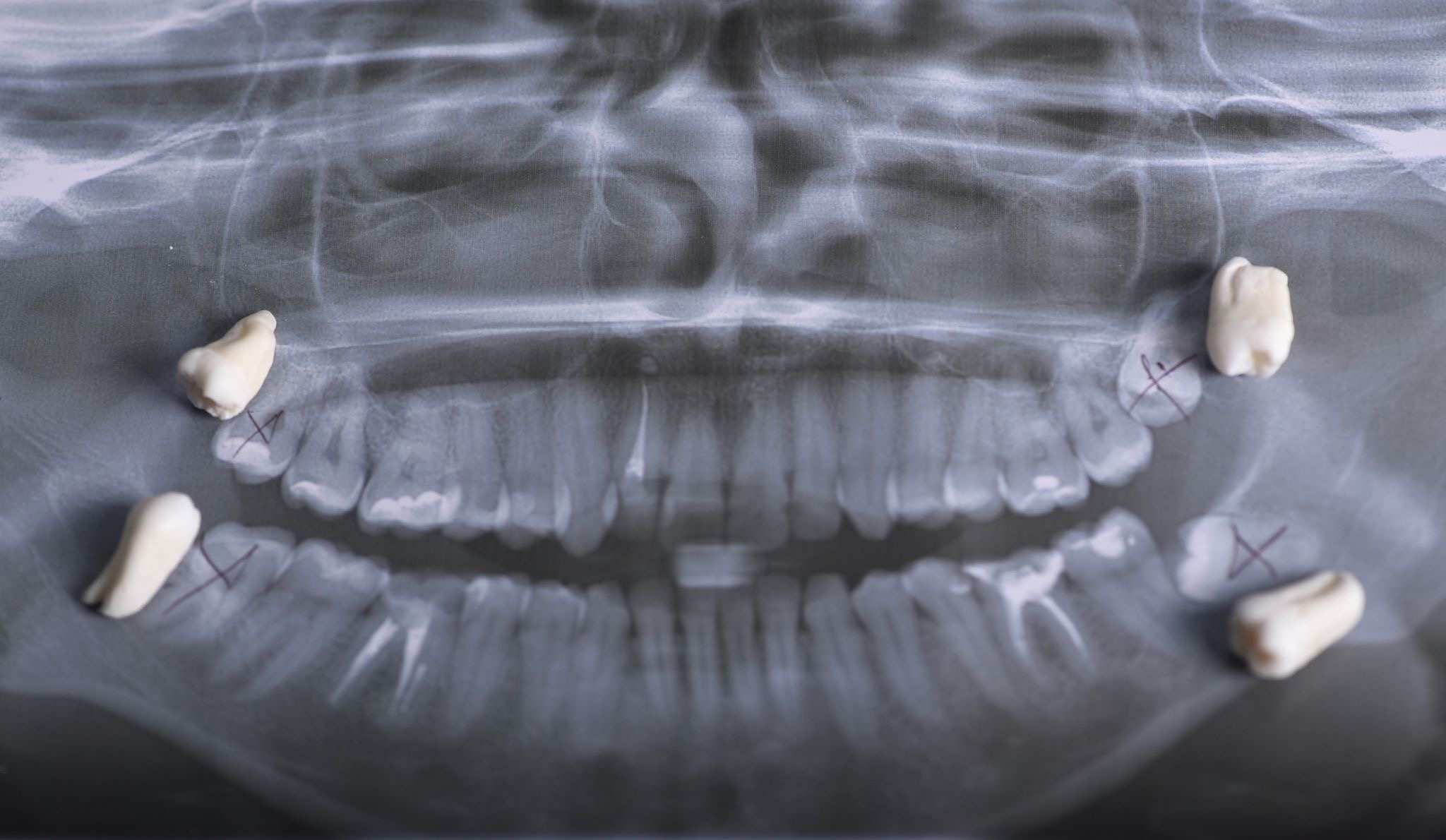
- Impacted eighth tooth (unerupted wisdom teeth).
Prices for wisdom tooth extraction
- Extraction of the upper wisdom tooth 2720 ₴
- Extraction of the lower wisdom tooth 3575 ₴
- Difficult/complex extraction of a wisdom tooth 4290 ₴
- Extraction of an impacted (unerupted) tooth
120 ₴ - Stitching the socket after tooth removal 500 ₴
- Stitching the extraction site with hemostatic material 900 ₴
- Stitching the surgical wound using a PRF membrane 2645 ₴
- Stitch removal 360 ₴
Retained “eights”
While any tooth can be retained, wisdom teeth are the most frequently affected. Retained teeth are those that fail to erupt. Often, impacted wisdom teeth are harmless and asymptomatic, and removal is primarily indicated for orthodontic purposes. Occasionally, an impacted eighth tooth may grow against the adjacent seventh tooth, resulting in misalignment or tooth loss.
How wisdom tooth extraction is performed: stages of the procedure
- Diagnosis: examination, periapical X-ray/CT scan to determine the position of the roots and proximity to nerves.
- Anesthesia: either local anesthesia or sedation.
- Extraction:
- The socket is stitched to promote stable and comfortable healing.
- Doctor’s recommendations for care during the first few days.
Wisdom tooth removal in Ivano-Frankivsk
At Masych Clinic, we remove wisdom teeth of any complexity. We specialize especially in the removal of unerupted (impacted) wisdom teeth. Thanks to modern anesthetics and the option to perform the procedure under sedation, you will not feel any discomfort, and the procedure will be easy and painless.
Complex (atypical) extraction
This type of extraction is necessary when the tooth is partially erupted, tilted, deeply impacted, or close to a nerve. It’s also used for fully erupted teeth with complex root structures that need to be divided and removed in sections. The procedure involves carefully separating (sectioning) the roots for safe removal.
Possible complications after wisdom tooth removal — what is normal and what is not.
Typical symptoms to expect in the first 1–3 days
During the first 1–3 days after wisdom tooth removal, the following symptoms are considered normal:
- moderate pain that gradually decreases;
- swelling of the cheek (peaks on days 2–3), then gradually subsides;
Complications that require attention
- Dry socket” (alveolitis): occurs when the blood clot after extraction does not form or is dislodged, leaving the socket “empty.” This causes sharp, throbbing pain on the 2nd or 3rd day, along with an unpleasant odor and discomfort.
- Other signs to watch for: a fever over 38 °C (100.4 °F), swelling that worsens after a few days, or severe bleeding that doesn’t stop on its own.
- Difficulty opening the mouth fully
When to seek urgent care
If the pain cannot be controlled with painkillers, pus appears, there is a bad odor, swelling increases, or you have difficulty swallowing or opening your mouth — an urgent dental examination is required.
After having your wisdom teeth removed: tips for a quick recovery
The key to a successful recovery is proper home care. Follow these guidelines for the first 3–5 days — this helps reduce the risk of dry socket and speeds up healing:
- apply a cold pack to the cheek during the first 3 days;
- Do not rinse your mouth during the first 24 hours to avoid dislodging the protective blood clot;
- Eat soft/cool foods, and avoid sleeping on the side where the tooth was removed;
- Do not apply heat to the area where the tooth was removed
- Do not drink alcohol or smoke for two weeks after your tooth extraction
- Do not engage in strenuous physical activity for two weeks
- Take medications prescribed by your doctor — according to the instructions.
- If any questions arise, consult your doctor.
How long does it take to recover after having a wisdom tooth removed, and when will the pain start to improve?
After having a wisdom tooth removed, it usually starts to feel better within 2–3 days. Swelling goes down in 3–5 days, the soft tissue closes over the socket in 1–3 weeks, and early bone formation takes 6–8 weeks.
Why should you choose Masych Clinic in Ivano-Frankivsk for wisdom tooth removal?
Wisdom tooth removal often makes patients feel anxious. That’s why it’s important to choose a clinic where you feel calm and confident, and where the procedure is as safe and comfortable as possible. At Masych Clinic, our advantages are:
- Surgeons’ experience in complex (atypical) cases.
- Accurate diagnosis and treatment planning (CT scan if needed).
- Comfort and safety: modern anesthesia and atraumatic extraction techniques
- We have advanced specialized equipment, like a surgical ultrasonic piezotome, to make extractions safer.
- We can remove complex teeth safely under sedation (medical sleep) or using nitrous oxide.
- Transparent pricing for wisdom tooth removal: the cost depends on how complex the procedure is, but you’ll know the price before we start.
Frequently asked questions and answers
Is it possible to have a wisdom tooth removed during pregnancy?
Yes, but only in extreme cases and preferably during the second trimester. Treatment is planned with the safety of both mother and baby in mind, using minimal intervention and avoiding X-rays unless absolutely necessary.
Is it necessary to do a CT (3D scan) before removal?
Yes, if the tooth is positioned atypically or close to nerves — a CT scan allows us to see the exact position of the roots and minimize the risk of complications. In standard cases, a panoramic X-ray (OPG) is sufficient.
Is it possible to remove several wisdom teeth in one visit?
Yes, this is possible and often convenient for the patient. The doctor evaluates overall health, the complexity of the teeth’s positions, and determines the optimal removal plan.
Is it possible not to remove a wisdom tooth if it doesn’t cause any problems?
Yes, but only if the tooth is growing correctly, has fully erupted, and doesn’t interfere with other teeth. The dentist needs to assess this clinically and on an X-ray — sometimes problems can occur even without pain.

Our results


- Implant prosthetics
- Zirconium crowns

- Implant prosthetics
- Zirconium crowns

- Implant prosthetics

- Implant prosthetics

- Ceramic veneers

- Zirconium crowns

- Ceramic veneers

- Whitening

- Whitening

- Zirconium crowns

- Zirconium crowns